Howdy folks! As someone who's spent more hours than I'd care to admit roaming the digital plains of Red Dead Redemption, I recently stumbled upon something that made me holster my controller and pick up a book instead. Imagine my surprise when I discovered that my obsession with virtual outlaws and frontier justice could actually lead me down a rabbit hole of real historical exploration! That's exactly what happened when I got my hands on Tore C. Olsson's "Red Dead's History: A Video Game, an Obsession, and America's Violent Past"—a book that's been causing quite a stir in both gaming and academic circles.
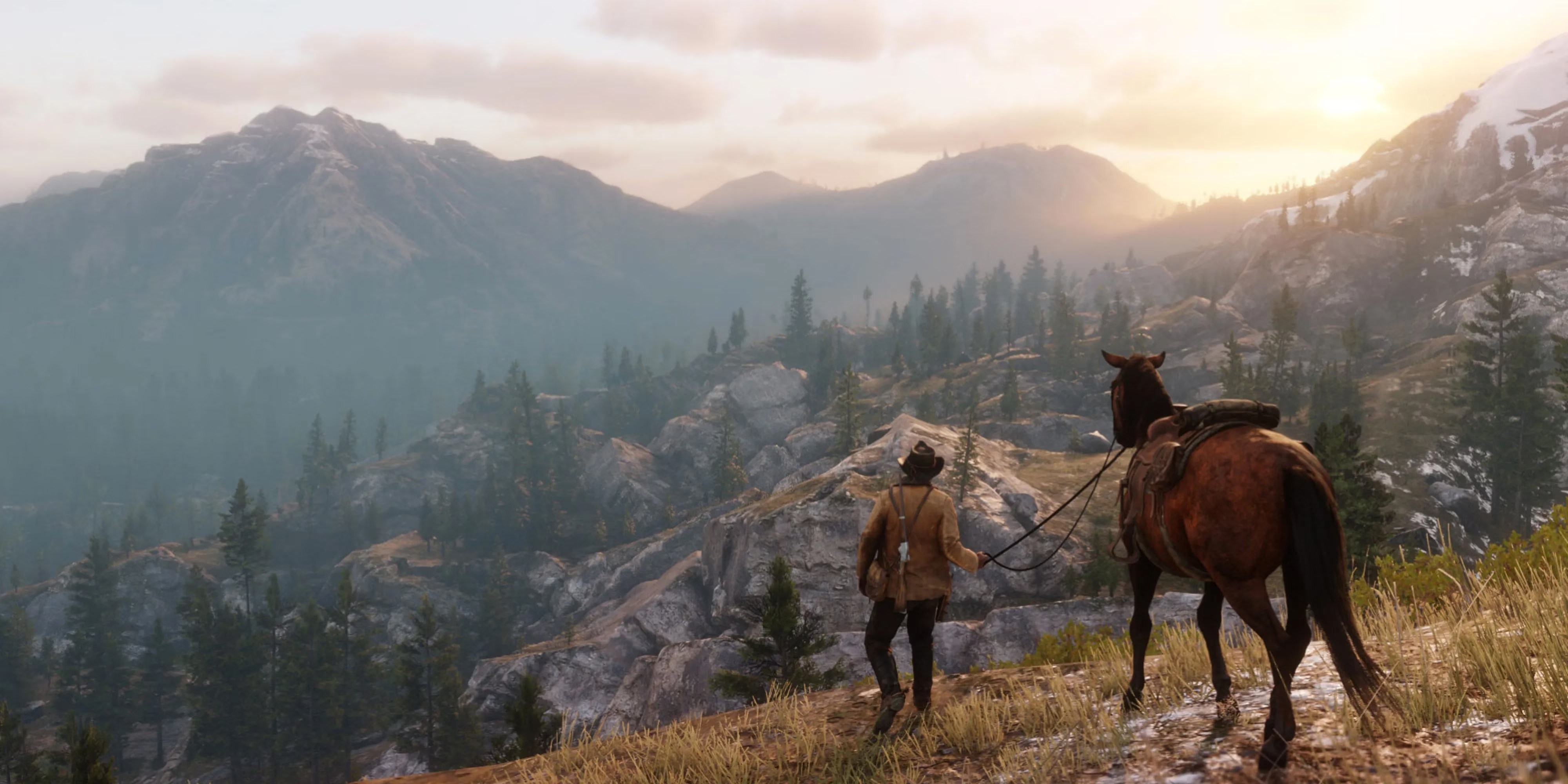
From Virtual Frontier to Historical Reality
Let me tell you, this book ain't your grandpappy's dusty history textbook. Olsson does something downright brilliant—he lassos together the fictional world we've all come to love with the brutal, complex reality of America's actual frontier years. As someone who's probably spent too much time playing poker in Valentine saloons and hunting virtual bison, I never stopped to ask: How close is this digital West to what actually happened?
Olsson wrangles this question like a seasoned ranch hand, taking readers through the tumultuous period between 1870 and 1920—the very era that inspired the Red Dead games. What I found fascinating was how he connects:
-
The game's fictional feud between the Van der Linde gang and the Pinkertons to real-life conflicts between outlaws and industrial capitalism
-
The racial tensions depicted in Saint Denis to America's actual Reconstruction-era struggles
-
The game's portrayal of indigenous communities to the tragic reality of Native American displacement
Why This Book Matters in 2026
In our current era of increasingly sophisticated gaming narratives, Olsson's approach feels particularly relevant. We're living in a time when video games have evolved from simple entertainment to complex storytelling mediums that can—and should—spark deeper conversations about history and society.
What really warmed my cold, black heart (to borrow Arthur Morgan's phrasing) was learning about Olsson's journey. During the COVID lockdowns, while most of us were just trying to survive another day of quarantine, this historian was playing Red Dead Redemption 2 with a scholar's eye. His realization? These games could be powerful teaching tools.
He didn't just write a book—he created an entire college course using Red Dead Redemption to teach American history! Now that's what I call leveling up in the education game.
The Critical Acclaim That's Got Everyone Talking
Don't just take my word for it. The reception has been nothing short of remarkable:
| Source | Verdict | Why It Matters |
|---|---|---|
| The Wall Street Journal | "Innovative and highly engaging" | Mainstream media recognizing games as legitimate cultural artifacts |
| Roger Clark (Arthur Morgan's voice actor) | "The perfect read for fans" | The actual creators endorsing historical analysis of their work |
| University History Departments | Adopted as teaching material | Academic validation of gaming's educational potential |
What Makes This Exploration So Compelling
Here's where Olsson really earns his spurs—he doesn't just compare game events to historical ones. He digs deeper into the thematic connections:
-
The Myth vs. Reality of Frontier Justice 🤠
-
How the game romanticizes certain aspects while accurately portraying others
-
The complex relationship between lawlessness and civilization
-
Why we're still fascinated by outlaw narratives in 2026
-
Economic Struggles That Mirror Modern Issues 💰
-
Land disputes and property rights that echo today's housing crises
-
Industrialization's impact on rural communities (sound familiar?)
-
The tension between traditional ways of life and "progress"
-
Racial Dynamics That Still Resonate ⚖️
-
How the games handle race relations with surprising nuance
-
Historical accuracy in depicting Reconstruction-era South
-
Parallels between past and present social justice movements
My Personal Takeaway as a Gamer
As someone who's probably committed more virtual crimes than I can count (all in the name of gameplay, of course), reading this book fundamentally changed how I approach gaming narratives. It's not just about completing missions or earning achievements anymore—it's about understanding the historical context that makes these stories resonate.
Olsson's work demonstrates that in 2026, the line between entertainment and education is blurrier than ever. Games like Red Dead Redemption aren't just escapism; they're interactive history lessons waiting to be unpacked.
Why You Should Saddle Up and Read This
Whether you're a die-hard Red Dead fan, a history buff, or just someone curious about how popular culture intersects with historical truth, this book delivers. It's:
-
Accessible 📚: Written in engaging prose that won't put you to sleep (unlike some history books)
-
Thought-provoking 💭: Raises questions that'll have you reconsidering both the games and real history
-
Timely ⏰: Perfect for our current era of media literacy and critical consumption
-
Fun 🎉: Seriously, it's more entertaining than it has any right to be
So if you've ever found yourself wondering about the real stories behind those digital sunsets and virtual campfire tales, do yourself a favor and check out "Red Dead's History." It might just transform how you play games—and understand America's complicated past. As for me, I'll never look at a virtual poker game in Saint Denis the same way again. Every bet, every bluff, every character at that table now carries the weight of real history behind their pixelated faces. Now if you'll excuse me, I have some actual reading to do... after just one more bounty hunt, I promise!