In early 2024, the indie game Palworld erupted onto the scene like a digital wildfire. Within two weeks of its early access launch, it shattered records on both Steam and Xbox Game Pass, becoming the biggest third-party debut in Game Pass history. The survival-crafting-meets-monster-collecting fusion captivated millions, but it also ignited a firestorm of controversy. Accusations of plagiarism against Pokémon flew, prompted by the unmistakable resemblance between Palworld’s Pals and Nintendo’s iconic creatures. The Pokémon Company even issued a formal statement vowing to investigate potential intellectual property infringements. Amid this chaos, one particularly biting critique came from an unexpected corner: Nathan S., then-Chief of Staff at Behaviour Interactive, the studio behind Dead by Daylight.
Nathan S. took to LinkedIn to share his blunt assessment — a post that was swiftly removed, perhaps due to its harsh tone. “I don’t think Palworld is very good,” he wrote. He systematically catalogued its flaws: poor game balance that made progression feel arbitrary, a disproportionately empty open world that stretched survival tedium across kilometers of sterile terrain, combat mechanics that he described as “boring and repetitive,” and an overall experience marred by bugs. To him, these were fixable issues. With enough money and post-launch patches, the numbers could be tweaked, the world could be filled, and the technical mess could be cleaned up. But one deficiency, he insisted, was forever beyond repair: the absence of “warmth.”
What truly separates Pokémon from Palworld, Nathan S. argued, is the intangible bond shared between trainer and creature. Despite logging hours in Palworld, he felt no meaningful connection to any of his Pals. They were instruments of labor, combat fodder, or mere resources — never companions. It was a critique that resonated with a vocal segment of the gaming community. Many players, especially those who grew up with Pokémon, echoed the sentiment that Palworld’s Pals lacked personality and emotional depth. The thermal bath, the feeding trough, the forced slave labor meme — they all pointed to a design that treated its monsters as tools rather than partners.
Yet even Nathan S. acknowledged the silver lining of Palworld’s astronomical success. He believed it could serve as a wake-up call for Game Freak, a studio often criticized for stagnating Pokémon games. And he identified the real winner in the situation: Xbox Game Pass. The subscription service had managed to snag an explosive hit, reinforcing its value proposition in a market increasingly dominated by day-one launches.
Fast forward to 2026, and the landscape looks quite different. Palworld has long since left early access, having reached its full 1.0 release the previous year. The developers at Pocketpair have been nothing short of prolific. The roadmap teased in early 2024 materialized into a cascade of content updates: over 150 Pals now inhabit half a dozen distinct biomes spread across vastly expanded islands. PvP arenas thrum with competitive activity, crossplay seamlessly unites platforms, and cooperative boss raids test player coordination. Bug fixes were prioritized early, and by mid-2025 the Xbox version had achieved near parity with the Steam edition. Performance patches smoothed frame rates, and weekly maintenance became a reassuring rhythm.
But what about the “warmth”? Has Palworld bridged that emotional chasm? The answer remains fiercely debated. On one hand, Pocketpair has introduced bonding mechanics — Pals now react to player actions more dynamically, offering affectionate animations when treated well, and they can learn special moves that only unlock after a certain trust threshold is reached. Story-driven quests added in the 1.0 update also give certain Pals narrative backgrounds, making them feel less like commodities. On the other hand, the core loop of Palworld is still cold industrial survival. Players still breed Pals for labor efficiency, cull the weak, and equip them with assault rifles. The very DNA of the game resists the saccharine formula of traditional monster-collecting; it’s a world where a Foxparks can be both a beloved pet and an emergency flamethrower. For many, that juxtaposition is the point — a darkly humorous twist that Pokémon could never provide.
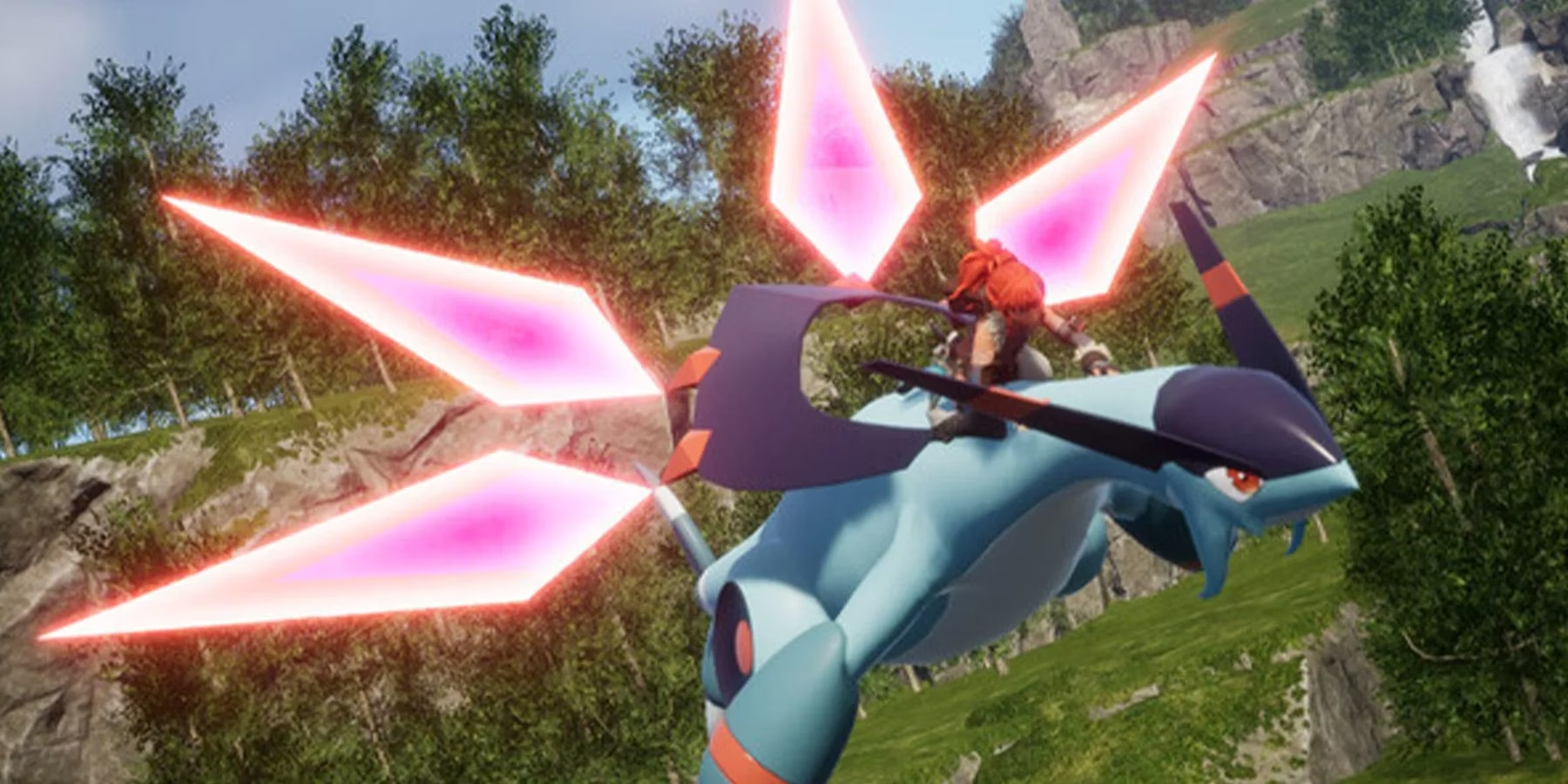
Financially and culturally, Palworld seems to have proven Nathan S. at least partially wrong. It didn’t fade into obscurity; instead, it has built a loyal, if irreverent, community. Players don’t speak about their Pals in the same tender tones they reserve for a starter Pokémon, but they do speak about them — with memes, with war stories, with a kind of grim satisfaction after surviving a raid on the back of a Jetragon. The “warmth” may simply have taken a different form, one more akin to the affection one feels for a dependable tool or a well-optimized loadout. As for Game Freak, the wake-up call may have rung more loudly in the halls of social media than in development offices; Pokémon games released after 2024 have shown incremental improvements but no radical overhaul.
The real winner, as Nathan S. predicted, might indeed be Game Pass. Palworld’s inclusion solidified the service’s reputation for delivering unexpected blockbusters. By 2026, day-one releases like this are no longer a surprise, but a standard expectation. In retrospect, the Dead by Daylight dev’s hot take aged with a complex texture. His technical criticisms were largely vindicated in early builds but got resolved over time; his philosophical cri de cœur about emotional connection, however, remains the defining divide in how gamers approach the title. Palworld didn’t become Pokémon, and it never intended to. It forged its own niche — a frozen, chaotic, strangely magnetic niche — that two years of updates have only deepened.