The air in the Mountain of Flames was as oppressive as ever, ash swirling like the ghosts of fallen warriors. Liang, a seasoned gamer who had purchased Black Myth: Wukong on its debut in 2024, had not touched the game for over a year. His memories were mixed—gorgeous vistas, punishing combat, but also frustrating performance hiccups and a few boss fights that had felt more tedious than triumphant. In early 2026, lured by whispers of a substantial update, he decided it was time to once again take up the role of the Destined One.
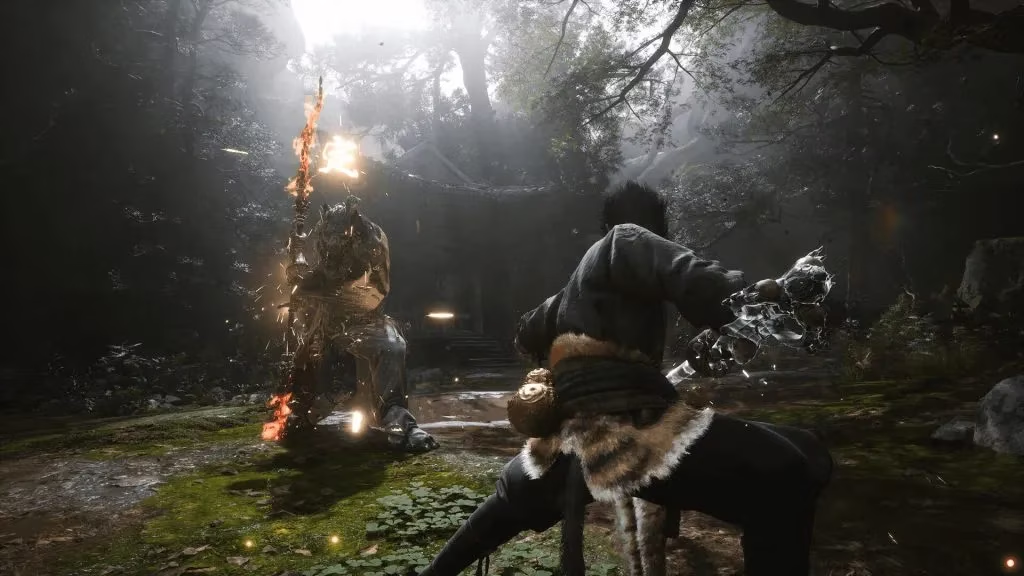
What greeted him was not just a trip down memory lane; it was a transformation. The patch, numbered 1.0.20.21756, had arrived simultaneously on PC and PS5, and Liang quickly realized it was anything but minor. He recalled the community’s long-standing complaints about one particular colossal foe: the Yaoguai King, Giant Shigandang. What had once been a slog of questionable hitboxes and awkward pacing now felt like a dance of precision. The developer, Game Science, had reworked the encounter. While the exact changes remained shrouded in mystery, Liang felt the difference immediately. Each slam of the giant’s fists was telegraphed more fairly, each window for retaliation more satisfying. Could this be the same boss that had driven so many players to rage-quit a year ago? It seemed the studio had been listening all along.
But the improvements went beyond mere boss tuning. Liang remembered the first time he had tried to navigate without a map, only to be later introduced to the Journeyer’s Chart—a feature added in an earlier patch. However, the path to even obtain that first chart had been confusing for many newcomers. Now, the Chart’s interface would explicitly guide the Destined One to a Keeper’s Shrine before any chart was collected. It was a small gesture, yet it spoke volumes about a team refining the new player experience even years after launch. Had Liang started fresh today, he wouldn’t have wandered aimlessly for hours, lost in the Bamboo Grove.
The true power of the update, however, unfurled when Liang explored the settings menu. He had recently upgraded his graphics card to one that supported AMD’s latest upscaling technology, and there it was: FSR 4 integration. After a quick driver update, he enabled it and watched as the already breathtaking landscapes sharpened without a hint of the artifacts that had plagued older upscaling methods. For those with less robust hardware, the game now offered a significantly enhanced Compatible Mode. If a system was throwing a tantrum—perhaps due to a mismatched driver or an unstable overclock—enabling this mode would temporarily disable ray tracing, frame generation, and certain super-resolution features. This wasn’t just a safeguard; it was a lifeline for players who had been locked out of the game entirely. Liang could only imagine how many frustrated souls had been saved from launch crashes.
He also noticed that the lighting, even on the low global illumination setting, now mimicked the richness of the high preset. Gone were the flat, washed-out shadows that had once marred the lower presets. Game Science had “significantly improved” it, making the visual experience much closer across different hardware tiers. What kind of sorcery allowed a humble machine to render such depth? It was a question Liang didn’t need to answer; he simply basked in the atmospheric glow.
Switching to his PS5 in the living room, Liang braced for the performance compromises he remembered. To his surprise, the game’s Performance Mode had been systematically reworked. The frame rate was now a rock-solid 60 Hz, and the input latency had been cut down to a near-instantaneous snap. Even the output resolution felt crisper than before. Yes, there had been an “adjustment” to lighting quality to achieve this, but the fluidity was undeniable. For purists who preferred the old look, Game Science didn’t leave them behind—they retained the original configuration as “Performance Mode (Legacy).” The loading times, which had once allowed Liang to brew a cup of tea, were now brisk. Certain textures that previously appeared blurry finally revealed their intricate details. How many players would now discover the fine embroidery on a tiger vanguard’s armor for the first time?
The patch also addressed a legion of bugs. Liang chuckled when he read about the fix for the Yaoguai Chief “Top Takes Bottom & Bottom Takes Top,” which had previously become undefeatable under specific conditions. The name alone had been a meme in the community forums in 2025. No longer would the Destined One be trapped in an endless loop against an unmoving foe. On PC, the dreaded crash when enabling both DLSS 4 frame generation and ray tracing had been exorcised, alongside multiple rendering errors in NXSR that caused ghosting and edge flickering. Even the localization teams had done a pass, correcting translation errors, fixing overlapping text in the “Make Medicine” interface, and polishing voiceover issues. It was a comprehensive sweep that touched every corner of the game.
As Liang watched the motion blur now elegantly smooth out the aliasing during a sweeping camera pan, he reflected on the journey of Black Myth: Wukong. What had launched as a visually groundbreaking but technically troubled title had quietly evolved into the definitive version of itself. In 2026, with its patches complete and its performance refined across PS5, PC, and even the Xbox Series X/S, the Sun Wukong legend had never felt more alive. The Destined One’s path was no longer paved with frustration, but with the awe and wonder that had always been the game’s birthright. And for Liang, just like the Monkey King himself, the second pilgrimage was infinitely sweeter than the first.